You Don't Have a Workflow Problem. You Have a Vendor Problem.
Every modern approval tool promises speed, simplicity, and scale. Most of them deliver — until you need something they don't offer. That's when you discover the real cost of building your business on someone else's foundation.
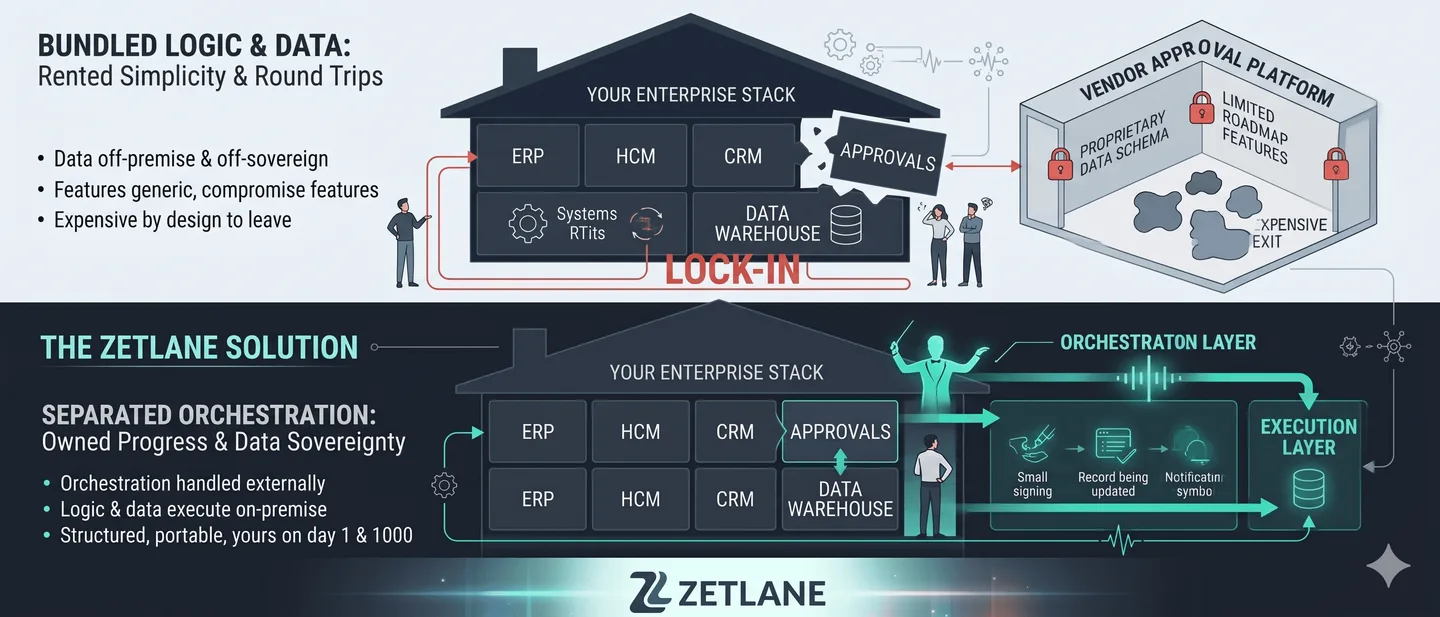
The technology is not the problem.
This is worth saying clearly, because most conversations about enterprise workflow approvals get stuck on the wrong question. Teams ask: which tool should we choose? When they should be asking: what are we giving up when we choose it?
We are living through the most capable period in enterprise software history. Event-driven architecture, real-time processing, AI-assisted routing, mobile-native experiences — none of this is experimental. It exists. It works. It is available right now.
And yet, enterprise approval workflows are still slow, still rigid, still frustrating. Not because the technology failed. Because of how that technology gets packaged and sold.
The pitch always sounds the same
A new approval platform arrives. The demo is clean. The setup is fast. The sales team walks you through a workflow that looks exactly like your problem — built in twenty minutes, running in the cloud, accessible from anywhere.
You sign. You integrate. You go live.
For a while, it works. Approvals move faster. The interface is better than what you had. People stop complaining — at least for a few months.
Then reality arrives.
A department head needs a specific escalation rule that the platform doesn’t support. You raise a ticket. The vendor says it’s on the roadmap. Six months later, you’re still waiting — because the roadmap is built for ten thousand other customers, not for you.
Your finance team wants to pull approval data into their own reporting system. You ask the vendor for an export. What you get back is a proprietary format that takes a developer three weeks to normalise. Because your data lives in their schema, in their database, processed by their logic — and they decide what shape it comes out in.
You start to wonder: can we switch? Your developers look at the integration work. New API. New authentication model. New data structures. Another learning curve. Another six months of disruption. Another licence negotiation.
That’s the moment you realise you didn’t buy a workflow tool. You rented a room in someone else’s building — and the lease has teeth.
What vendor lock-in actually costs
The obvious cost is the subscription. That number is visible on the invoice and easy to challenge.
The hidden costs are harder to see and far more damaging.
Your data is off-premise whether you realise it or not. Every approval request, every decision, every escalation record — processed outside your infrastructure. Vendors will show you their ISO certifications, their SOC 2 reports, their data residency guarantees. What they won’t show you is the gap between data security and data sovereignty. Secure means protected. Sovereign means yours. These are not the same thing.
Your features are the vendor’s features. Enterprise approvals are not generic. A procurement approval at a pharmaceutical company has different compliance requirements than one at a logistics firm. An HCM workflow at a 500-person organisation has different delegation rules than one at 50,000. When your approval logic lives inside a platform built for the entire market, you are always running a compromise. The platform is precise for no one and adequate for everyone.
Your scale is their scale. You want to process ten thousand approval events a month. Their pricing model was designed for a different kind of volume. You need sub-second response times. Their architecture was built around batch processing. You want to add a new system as an approval source. They support eight out of the twelve systems in your stack. You can push and pull and workaround — but you cannot fundamentally change what the platform was designed to do.
Your exit is expensive by design. This is not accidental. The deeper you integrate, the more your approval logic gets encoded in their proprietary configuration language, their workflow builder, their decision tables. By the time you want to leave, the cost of leaving is so high that staying — even at a price that no longer makes sense — feels like the rational choice. Lock-in is not a bug in the vendor model. It is a feature.
The analogy that keeps proving itself
You own a house. It has everything you need — your data, your systems, your people, your processes.
A vendor arrives and says: we have a better room for your approvals. Modern. Fast. Cloud-native. And you can move in this week.
So you move your approval process into their room. The room is nice. But it is their room. The walls are where they put them. The doors open the way they decided. You cannot knock down a wall. You cannot add a room. And the rent goes up every year.
Meanwhile, back in your house, everything else keeps running — your ERP, your HCM, your CRM, your data warehouse. Your approvals are the only thing that moved out. And now every time those systems need to talk to your approvals, they have to make a round trip to someone else’s building.
The promise was simplicity. What you got was dependency.
The architecture that breaks the pattern
The problem is not cloud. The problem is not SaaS. The problem is the assumption that the vendor needs to own your logic and your data in order to give you a better experience.
That assumption is wrong.
Workflow orchestration and workflow execution are two different things. Orchestration is the routing, the escalation, the chaining, the delegation — the flow of a decision. Execution is what happens when the decision is made — the record updated, the transaction approved, the notification sent.
Most vendors bundle these together because bundling creates dependency. If your logic and your data both live inside their platform, you cannot leave one without leaving both.
The better model separates them. The orchestration layer handles the flow — routing requests to the right people at the right time, managing escalations, tracking chains, enforcing delegation rules. But the data never leaves your systems. The decision record writes back to your database. The approval logic executes in your environment. The orchestration layer is a conductor, not a vault.
This is what Zetlane is built on.
We orchestrate the workflow. Your data stays on your premise — always. We never store it. We never process it. We never become the custodian of something that should belong to you.
And because we only orchestrate, you are never locked to us either. Your approval data is structured, portable, and yours. If you want to visualise it your own way — build your own dashboard, connect your own reporting tool, pipe it into your own data warehouse — you never have to ask us for permission. Because we never took it from you in the first place.
Want to add a new approval source? It plugs in. Want to change the escalation logic? You change it. Want to switch the system that executes the final decision? No relearning. No re-licensing. No migration project.
You stay in your house. We just make sure the right decisions reach the right people — faster, smarter, and without ever asking you to hand over the keys.
The question worth asking before you sign
Before any enterprise commits to an approval platform, there is one question that cuts through every demo and every data sheet:
If we needed to leave this platform in twelve months, what would that actually take?
If the vendor hesitates, or reaches for reassurances, or starts talking about migration tools they haven’t built yet — you have your answer.
The right workflow solution should make that question boring. The exit should be as clean as the entry. Your data should be yours on day one and yours on day one thousand.
Anything less is not a workflow solution. It is a dependency — dressed up in a good interface and sold as progress.
Zetlane orchestrates enterprise approval workflows without ever taking ownership of your data or your logic. If you’re evaluating approval platforms and want to understand what genuine data sovereignty looks like in practice, we’d like to talk.
Want to see Zetlane in action?
Get in touch →