The Approval That Never Arrives
How enterprise workflows evolved across five decades — and why, despite all the technology, the approval bottleneck is still the same.
You sent the request on Monday morning.
By Wednesday, you’re following up on email. By Friday, you’re walking to someone’s desk. The approval finally comes through the following Tuesday — nine days after you clicked submit.
The project is delayed. The vendor is frustrated. And somewhere in your organisation, someone is sitting on seventeen other requests just like yours.
This is not a technology problem. This is not a people problem. This is a design problem — one that has been carried forward, unquestioned, from decade to decade, system to system, upgrade to upgrade.
And it’s time we talked about how we got here.
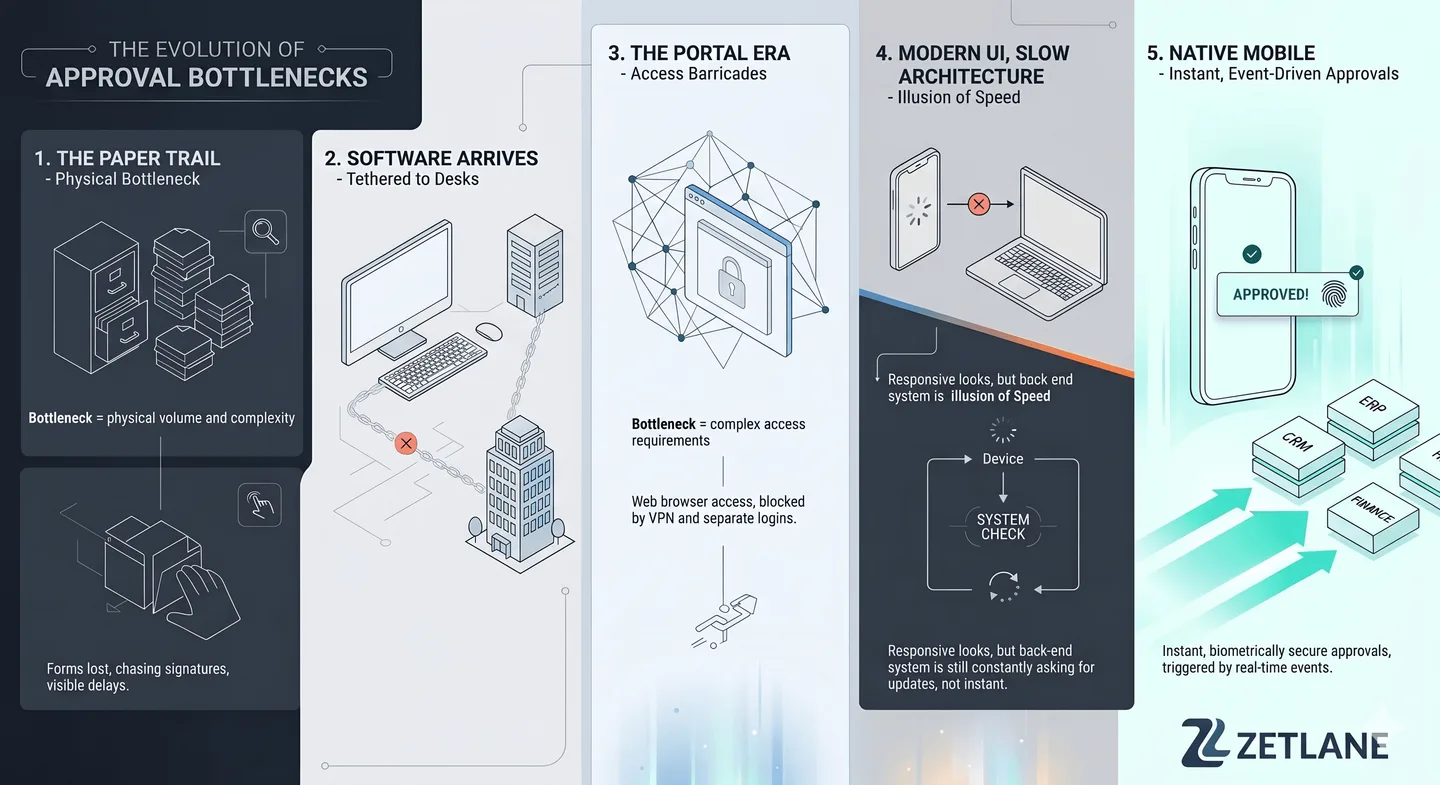
Era 1 — The Paper Trail (And The Filing Cabinet That Ate Your Request)
Before software, approvals lived on paper.
A purchase request meant filling out a form, getting a signature from your manager, walking it to finance, waiting for the department head to be in the office, and then — if you were lucky — receiving a stamped copy back within the week.
The system worked, barely, because everyone understood it. The bottleneck was visible. If your form was stuck, you knew exactly whose desk to walk to.
But scale that across a 10,000-person organisation, across multiple offices, across time zones — and the paper trail becomes a paper maze. Requests disappeared. Approvals were lost in transit. Audits were a nightmare. And the only way to know where your request stood was to physically chase it.
The filing cabinet was the system of record. Human memory was the workflow engine.
Era 2 — Software Arrives, But The Mental Model Doesn’t Change
In the late 1990s and early 2000s, enterprise software changed everything — or so we thought.
ERP platforms arrived. Workflow modules were built. For the first time, approvals could be routed automatically. No more walking forms across floors. The system would send the request to the right person, track it, escalate it, and log it.
It felt like a revolution.
But here’s what actually happened: we took the paper process and digitised it. The approval inbox replaced the physical inbox. The workflow rule replaced the routing stamp. The screen replaced the form.
The mental model — someone must review this, then pass it forward — never changed. We just gave it a keyboard.
Approvers now needed to be logged into the system, on a desktop, on the corporate network, during business hours. The geography problem was solved. The availability problem was not.
And a new problem emerged: the people who needed to approve things were often the people least comfortable inside enterprise software. Executives. Department heads. Senior managers. The very people whose time was most constrained were now expected to navigate complex ERP interfaces to click a single button.
The bottleneck moved from the filing cabinet to the inbox — and stayed there.
Era 3 — The Portal Era: A Friendlier Face on The Same Problem
By the mid-2000s, enterprises recognised the usability problem and reached for a solution: the web portal.
Browser-based interfaces brought workflow approvals out of thick-client desktop software and into something that looked, at least superficially, like a normal website. A unified inbox. A list of pending tasks. Click to approve. Click to reject.
Progress — real progress.
But the underlying architecture hadn’t changed. You still needed to be on the corporate network, or fighting through a VPN. You still needed to remember a separate login. The portal was often slow, often clunky, and often maintained by an IT team stretched across a dozen other priorities.
And mobile? Mobile was an afterthought at best. The portal was designed for a 1280×1024 desktop monitor. Pinch-and-zoom was not a workflow strategy.
The organisations that invested in these portals spent millions. And their approval cycle times improved — somewhat. But the fundamental dependency remained: the approver must be at a desk, logged in, and paying attention.
In 2008, the iPhone arrived. In 2010, enterprise IT was still debating whether to support it.
Era 4 — “Modern” UX, Ancient Architecture
The next wave brought responsive design, cleaner interfaces, and a genuine attempt to make enterprise approvals feel less painful.
Platforms across the enterprise software landscape — ERP, ITSM, HCM, CRM — launched unified inbox experiences. The pitch was compelling: one place for all your approvals, across all your systems, with a modern interface that works on any device.
And on the surface, it delivered.
But underneath the polished UI, the architecture remained largely unchanged. Most of these systems still relied on polling — repeatedly checking for new tasks on a fixed interval, sometimes every 30 seconds, sometimes every few minutes. Not event-driven. Not instant. Just a loop, running in the background, asking “anything new yet?” over and over again.
The consequence? A task assigned to you at 9:00 AM might not appear in your inbox until 9:01 — or 9:05 — depending on where you sat in the polling cycle. For a high-value approval in a procurement or HR workflow, that lag compounds across every step in the chain.
Mobile support arrived, but often as an adaptation of a desktop experience — not a rethinking of it. Notifications were unreliable. Offline capability was nonexistent. And the moment anything went wrong, the answer from IT was always the same: log in from your desktop and try again.
Meanwhile, every other app on your phone had figured out push notifications. Your food delivery app knew the second your order left the restaurant. Your bank notified you the moment a transaction hit your account.
Your enterprise approval system was still polling.
Era 5 — What The New Era Actually Requires
Here’s the honest truth: the technology to fix this has existed for years.
Event-driven architecture. Push notifications. Biometric authentication. Offline-capable mobile apps. These are not emerging concepts — they are table stakes in consumer software. The question is why enterprise workflow has been so slow to adopt them.
Part of the answer is inertia. Organisations invest heavily in platforms and are reluctant to deviate from the vendor roadmap, even when that roadmap moves slowly.
Part of the answer is complexity. Enterprise workflows are deeply tangled with business rules, compliance requirements, and organisational hierarchies that make change feel risky.
And part of the answer is that nobody has built the right abstraction layer — something that sits above the complexity of any individual platform and delivers a genuinely modern approval experience, regardless of what system is underneath.
The new era of enterprise workflow approval looks like this:
This is not a vision. This is an engineering decision. The tools exist. The question is whether the enterprise software world is willing to build for how people actually work — or keep rebuilding the filing cabinet with a better coat of paint.
Why This Matters Now
Every day, across every industry, approvals are sitting in inboxes. Procurement decisions delayed. Hiring frozen mid-process. Customer escalations waiting on a manager who is travelling. IT changes stuck in a queue that nobody is watching.
The cost is not just time. It is momentum. It is trust. It is the quiet frustration of people who know the system should work better but have stopped expecting it to.
Thirty years of enterprise software evolution has brought us a long way from the paper form. But on the specific problem of getting a decision from the right person at the right moment — we have not moved nearly far enough.
That is the problem Zetlane is being built to solve.
Not for one platform. Not for one industry. For any organisation where a decision is waiting on a person — and that person deserves a better way to act.
Want to see Zetlane in action?
Get in touch →