You're Paying to Wait in Someone Else's Queue
Rate limits. Payload caps. Consumption quotas. Every modern approval platform comes with a ceiling you didn't know about until you hit it. And when you hit it, it's always at the worst possible moment.
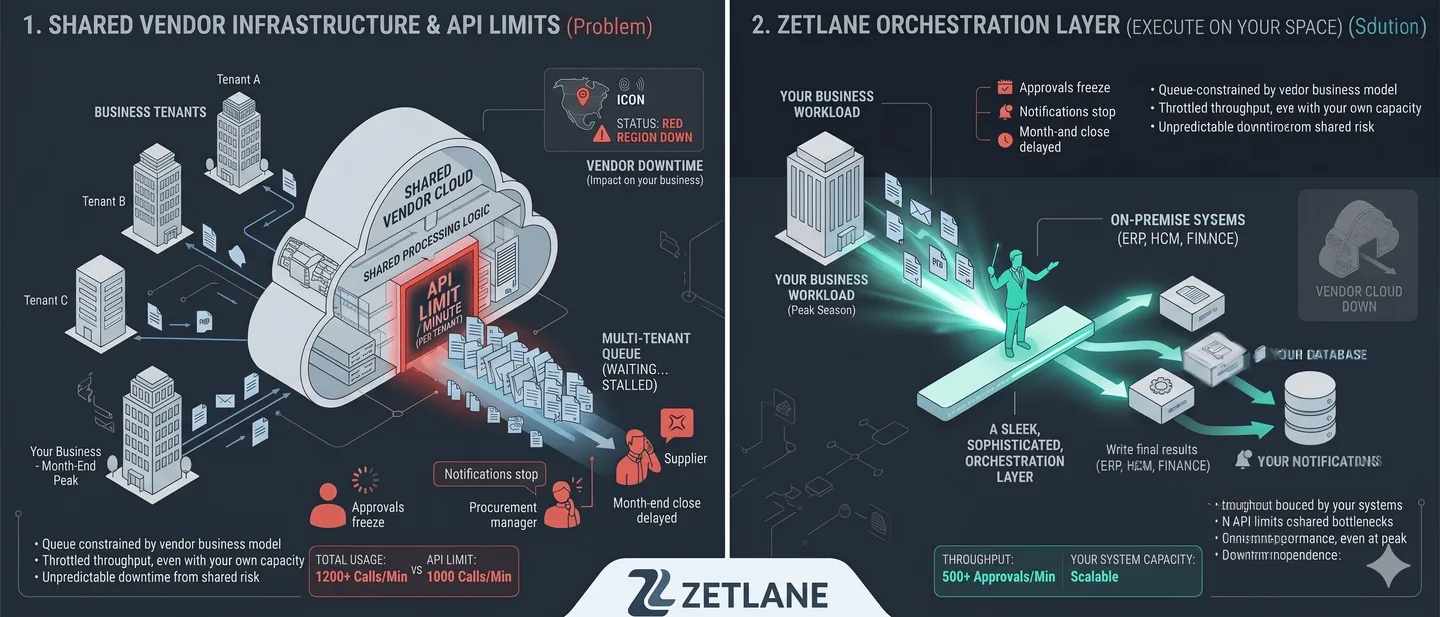
It’s the last week of the month.
Your finance team is running month-end close. Fourteen invoice approval chains are in flight simultaneously. The procurement team just pushed through an emergency purchase order for a supplier who won’t wait past Friday. HR is processing end-of-quarter headcount approvals that feed directly into payroll.
Everything is moving at once — exactly the way a functioning business is supposed to move.
And then the platform stops.
Not because your network went down. Not because your servers failed. Because somewhere in the fine print of the subscription you signed eighteen months ago, there is a line that reads: 1,000 API calls per minute per tenant. And you just hit it.
The approvals queue. The notifications stop firing. The escalations freeze. Your finance controller is staring at a spinner. Your procurement manager is on the phone with a supplier who is losing patience. And your IT helpdesk is raising a support ticket with a vendor who will respond — according to their SLA — within four business hours.
Welcome to the hidden architecture of modern approval software.
The limits are real. The reason they apply to you is not.
Every major approval platform has them. Rate limits. API call quotas. Payload size restrictions. Concurrent request caps. Monthly consumption ceilings that reset on a calendar date that has nothing to do with when your business actually needs to move.
Ask the vendor why these limits exist and they will give you an honest answer: fairness. They are running hundreds or thousands of customers on shared infrastructure. The limits exist so that one customer’s spike doesn’t degrade everyone else’s experience.
That is a legitimate engineering problem. And it is entirely their problem — not yours.
Your approval workload is yours. Your transaction volume is yours. Your peak periods — month-end, quarter-end, hiring cycles, budget season — are predictable patterns that your business has always managed. The fact that you now have to fit those patterns inside a box designed for the average of ten thousand other companies is not a constraint you inherited from your business. It is a constraint you inherited from your vendor’s business model.
The resources required to run enterprise approval workflows are, in absolute terms, modest. Routing logic. State management. Notification dispatch. Audit logging. These are not computationally expensive operations. A well-architected approval system running on your own infrastructure would consume a fraction of the processing power sitting idle in your existing environment right now.
But you are not running on your own infrastructure. You are running in a shared tenancy, queued alongside every other customer who signed the same contract, subject to the same ceilings — regardless of what your hardware could handle, regardless of what your business actually needs.
You are not resource-constrained. You are queue-constrained. There is a difference, and it costs real money.
Downtime you didn’t cause and can’t fix
API limits are predictable. Vendor downtime is not.
At some point — and this is not speculation, this is a certainty for any cloud-hosted platform — your approval vendor will have an incident. A region goes down. A deployment introduces a regression. A dependency fails upstream. The status page goes amber, then red. The incident response team posts an update every thirty minutes.
And every approval in your organisation stops.
Not because your systems failed. Not because your team made a mistake. Because your critical business process — the mechanism by which your organisation makes decisions — is hosted somewhere you do not control, operated by a team you do not manage, running on infrastructure you cannot inspect.
Vendor downtime is your downtime. Full stop.
In any other part of the enterprise stack, this dependency would be treated as unacceptable risk. You would not host your financial ledger on a platform where a vendor outage meant no one could record a transaction. You would not run your HR system on infrastructure where a deployment gone wrong meant no one could process payroll.
But somehow, for approval workflows, this dependency became normalised. The convenience of a fast setup and a clean demo outweighed the question nobody asked in the procurement meeting: what happens to our business when this goes down?
The complexity behind the clean interface
There is one more cost that rarely appears on a vendor comparison sheet.
Modern approval platforms sell simplicity. The interface is clean. The workflow builder is drag-and-drop. The onboarding is measured in days, not months. This is genuinely true — for the first ninety days.
What the demo does not show is what happens when your requirements diverge from what the platform was designed for.
You need a four-level approval chain where the third approver changes dynamically based on the transaction currency. The platform supports three levels natively. The fourth requires a webhook, a custom integration, and a configuration that lives outside the visual builder in a JSON file that only two people in your organisation know how to edit.
You need to re-route an approval mid-flight because the original approver left the company. The platform has a delegation feature — but it only works if delegation was configured before the workflow started. Retroactive re-routing requires an admin override that generates an audit exception that your compliance team now has to explain in the next review.
Each of these workarounds is possible. Each of them adds a layer. Six months in, the clean interface is a skin over a configuration that nobody fully understands, maintained by people who are half a resignation away from becoming irreplaceable.
The modern UI did not reduce complexity. It relocated it — deeper into the system, further from visibility, harder to change.
What the right architecture looks like
The root cause across all of these problems is the same: the approval logic and the approval infrastructure are bundled together inside a platform you do not own.
Separate them, and the problems dissolve.
If the orchestration layer — the routing, the escalation, the chaining, the audit — runs independently of the vendor’s shared infrastructure, there are no queue limits to hit. Your throughput is bounded by your own systems, which are already sized for your business. If the vendor has an outage, your orchestration layer continues running because it is not their tenant.
If the approval logic is expressed in your own terms — not encoded in a proprietary workflow builder — you can change it without raising a ticket, without waiting for a roadmap, without discovering that the configuration lives in a JSON file nobody documented.
This is the architecture Zetlane is built on. We handle the orchestration — the routing, the escalation, the multi-level chains, the delegation, the real-time event handling. But the infrastructure is yours. The data is yours. The throughput ceiling is yours.
There is no API limit between you and your own approval process. There is no vendor incident that takes your decisions offline. There is no proprietary configuration layer accumulating complexity behind a clean interface.
When your business needs to move at month-end, it moves. Not when the queue clears.
The question that reveals the architecture
Next time an approval platform demo lands in your calendar, ask this before the presenter gets to the pricing slide:
When we hit your rate limit during a peak period, what exactly happens to our in-flight approvals?
Watch how long it takes them to answer. Watch whether they reach for documentation or reach for reassurance. The answer will tell you whether you are evaluating a tool built for your business — or a tenancy built for their business model.
The limits are their constraint. They should not be yours.
Zetlane orchestrates approval workflows without shared infrastructure, consumption quotas, or vendor uptime dependencies. If you’re running critical approval processes on a platform with a ceiling, let’s talk.
Want to see Zetlane in action?
Get in touch →